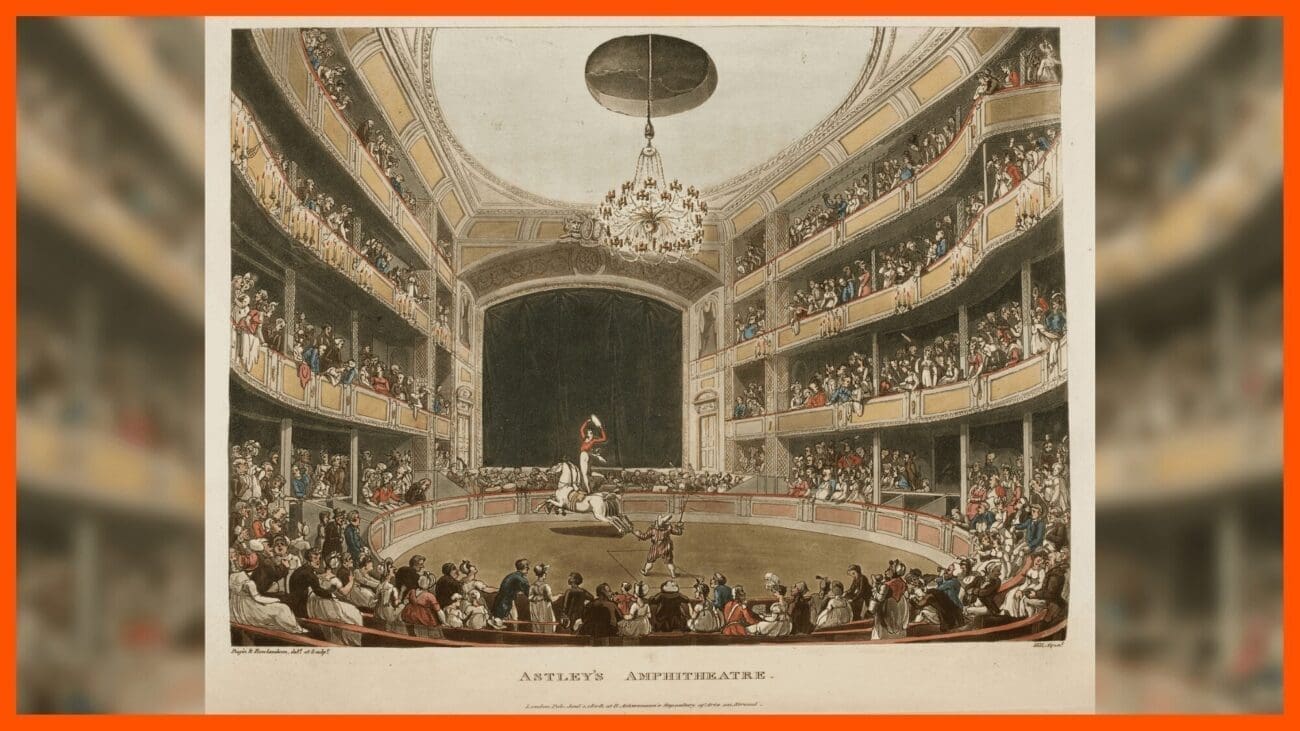
Astley’s Amphitheatre from Microcosm of London published 1808-10
from the archive of Waterloo Festival 2020.
For centuries Waterloo has been one of London’s most notable homes for entertainment. In 1768 a man named Philip Astley opened his famous Amphitheatre and changed the history of entertainment forever.
Philip Astley’s Amphitheatre was opened in 1768 and is recognised as the world’s first modern circus. In his early life Astley was a distinguished military man and when he left the army he became a trick horse rider performing at the various pleasure gardens around London, including those at Vauxhall and Ranelegh. In 1768 he made the decision to open up his own riding school and teach his trade to others. Each night he would perform his tricks to a paying audience, capitalising on the Georgian obsession outdoor spectacles.
Later, he established what we now recognise as the modern circus, adding acrobats, tight rope walkers and even clowns to his motley crew of performers. Even today’s standard 42-foot diameter for circus rings comes from Astley’s original ring. The amphitheatre burnt down in 1794 and was rebranded as “Astley’s New Amphitheatre of the Arts”. Then in 1803 it burnt down again, and later in 1841.
Peter Cunningham in his Handbook of London – Past and Present (1850) describes the festivities at the amphitheatre

The amphitheatre lasted well past Philip Astley’s death in 1814 and has persisted, to this day, in our cultural consciousness. Astley’s was paid a visit in Jane Austen’s Emma:
Despite its age, the amphitheatre was still influential within Victorian culture. Charles Dickens’ wrote a short story titled Astley’s. He also mentions it in Sketches by Boz, The Old Curiosity Shop, and the circus is also referred to in Hard Times and Bleak House. The amphitheatre was originally located on Westminster Bridge Rd (between Lambeth North station and Morley College!) until it was finally demolished in 1893.