
A history of St John’s Waterloo
As part of our 200th anniversary celebrations, St John’s is proud to publish Waterloo Parish: A History by Peter Jefferson Smith (1939-2018).
This book chronicles the rich history of St John’s Waterloo, beginning with early 19th-century debates in Parliament over funding its construction. It delves into pivotal events like the church’s bombing in 1940 and subsequent rebuilding, highlighting the remarkable people who have shaped the parish and supported its social and charitable work over the past two centuries. The book concludes with an epilogue by Mark Ormerod, documenting the recent redevelopment of St John’s.
A short history of St John’s Waterloo
St John the Evangelist Waterloo, Grade II* was constructed 1822-24 to designs by Francis Bedford and built over swampy ground close to the Thames. It was one of 612 Commissioners’ Churches intended for a rapidly growing urban population and is the largest of four in Lambeth, all in the Greek Revival style. The others are St Matthew’s Brixton, St Mark’s Kennington, and St Luke’s Norwood.
St John’s enjoyed a large congregation. A census of 1851 records congregations of 736 in the morning and 719 in the evening. During the 19th and early 20th centuries, to make its plain Georgian interior more “church-like”, the interior was remodeled by some of the great church architects of the time, Arthur Blomfield, J. J. Stevenson, and Ninian Comper. By 1927 the chancel had an elaborate dark oak reredos, marble floors and over the altar, a large pillared canopy, known as a baldacchino.
In 1877, Octavia Hill, later one of the founders of the National Trust, led a campaign to clear London churchyards of their graves and open them as gardens for the urban poor. She is said to have been delighted by the results at St John’s and to have paid for the inscription of a line of poetry by George Herbert along the church’s garden wall.
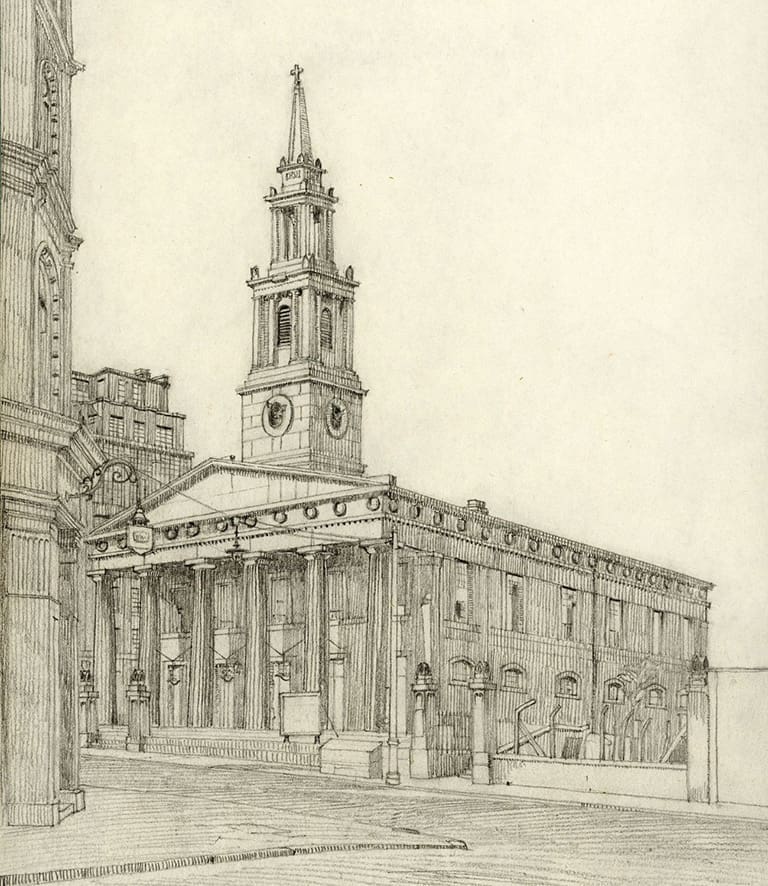
Pencil drawing by Edgar W. Pitt, dated July 1943.
Reproduced courtesy of Lambeth Archives.
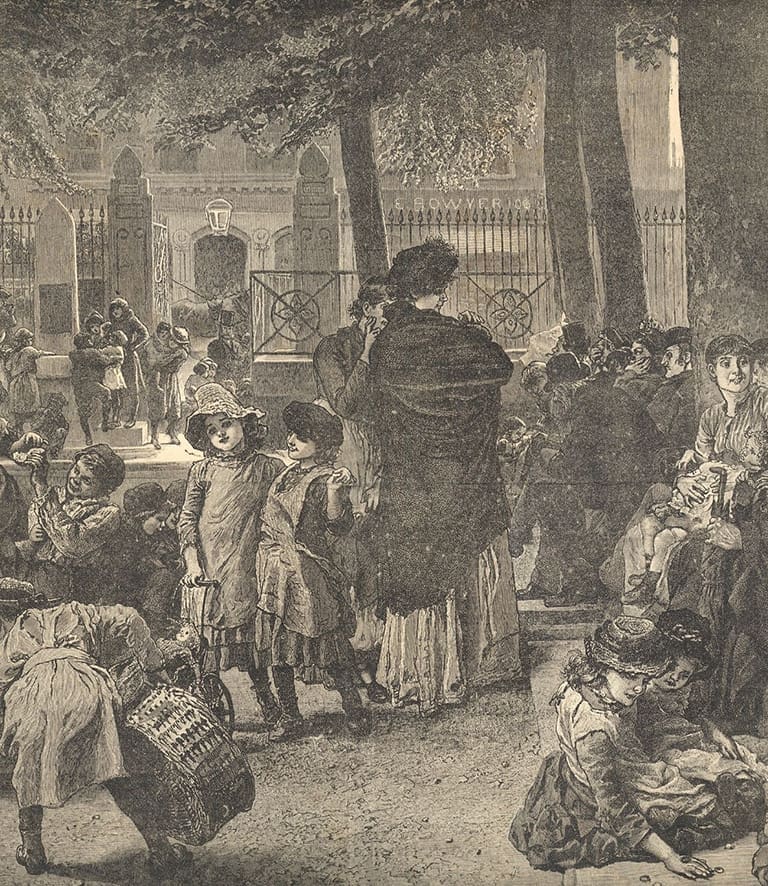
‘Open spaces for London: A scene in the churchyard of St John’s church, Waterloo Road, recently thrown open to the public’. Several of Lambeth’s churchyards were turned into public spaces during the 1880s by Lambeth Vestry.
Engraving published in ‘The Graphic’, dated 26th November 1887.
Octavia Hill told a lecture audience that St John’s churchyard was “more like a country garden … than any other I have seen. [The Vicar] has stumps prepared for ferns to grow on (and wants some, by-the-way, which some of you might send him); he has a nice bank, winding walks between the turf, knows which side of the church his wisteria will grow, spoke with hope of getting the large blue clematis to flower, wants numberless creepers to cover the church walls, and wreathe around and make more beautiful the few tombs which he leaves unmoved …”
At the height of the Blitz in December 1940, a firebomb fell through the roof, destroying the nave. The crypt was being used as a bomb shelter and proved its worth: 150 people were shocked but unharmed. The next day, the vicar placed a notice on the railings:
“This Waterloo Church… mother of souls in this parish, true to her maternal instinct, gathered the full fury of the blow into her heart and gave her life for her children.”
In 1951, the church was restored by architect Thomas Ford and reopened at the official church of the Festival of Britain on 26th April. It was a focus for the Festival, and has remained a place of encounter between the arts, society and faith ever since.
The crowning glory of the restored church are two murals by Hans Feibusch, commissioned by Ford to replace the east window, blown out by the firebomb. Feibusch was a German Jewish refugee and came to be responsible for more murals in Church of England churches than any other artist in its entire history – though he is only now beginning to attract the recognition he deserves.
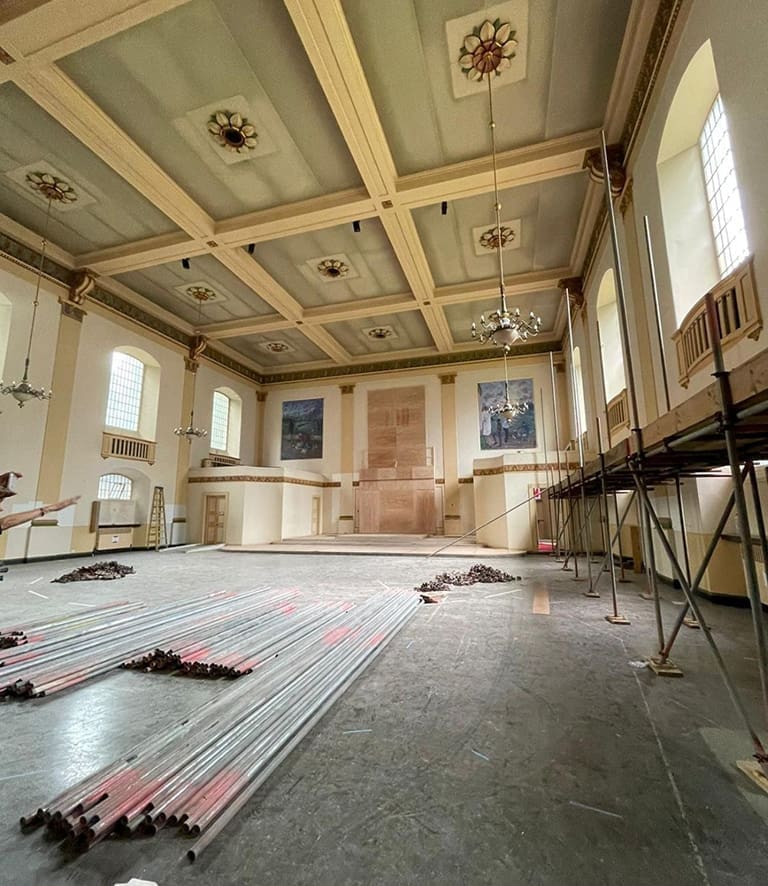
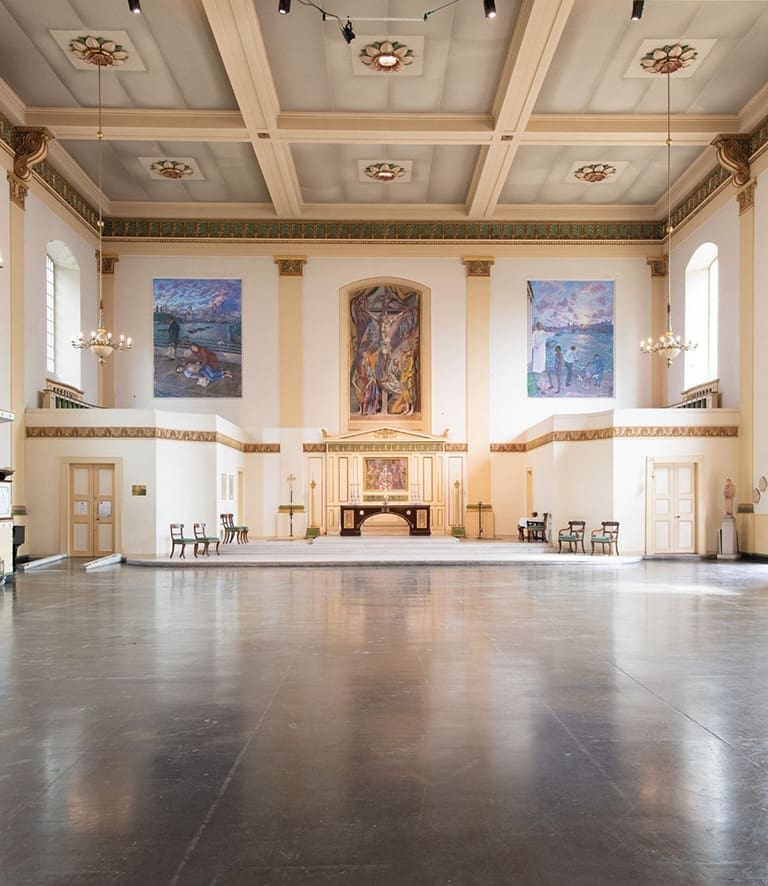
From 1984 to 2003, when this part of the South Bank was known as Cardboard City, the crypt was used as a homeless centre and serving the homeless is still central to our mission.
In July 2021, after a year’s delay due to the Covid pandemic, work began on the first major restoration of St John’s since 1951. This £6 million project included a stunning redecoration of the nave and a complete remodel of the crypt, enabling this iconic landmark to fully realise its commitment to be here the people of London and Waterloo for the century ahead. The church proudly reopened in October 2022.
Join us or support our work
Talk to us about getting involved in one of our projects, becoming a partner organisation, volunteer or patron.