


Sculpture Exhibition: Morley College
Thursday 9th July, 6:45pm to Tuesday 1st September 2026
The Churchyard Garden, St John’s Waterloo
Sculpture students, staff and artists at the historic Waterloo Campus of Morley College London are pleased to present a free sculpture exhibition at St John’s Waterloo as part of Waterloo Festival. The works have been produced over the last year in response to the Festival’s theme of ‘Now I Make A Leaf Of Voices’. There will be work displayed in various sculptural materials such as ceramic, steel and found objects on and around the front churchyard responding to the stone plinths and surrounding trees. The garden sculpture will be displayed all summer until early September 2026.
More information about Morley Waterloo Sculpture courses can be found on the website: www.morleycollege.ac.uk/subject-areas/sculpture
Exhibiting Artists:
Patsy Hickman, Jack Davies, Fola Odumosu, Rosalind Smith, Susan Caffrey, Sabrina Rodrigues, Basak Alpas, Susie Lonie, Kirsten Newbigging, Teresa Hedderwick, Thursday’s Children, Brigid Green, Michelle Cole, JP Guerrier, Saratu Audu, Luke Jones, The Pelham clay slappers
Opening times:
Open every day* between Thursday 9th July and Monday 1st September 2026.
*Open times dependant on the churchyard’s opening hours as designed and followed by Lambeth Council.
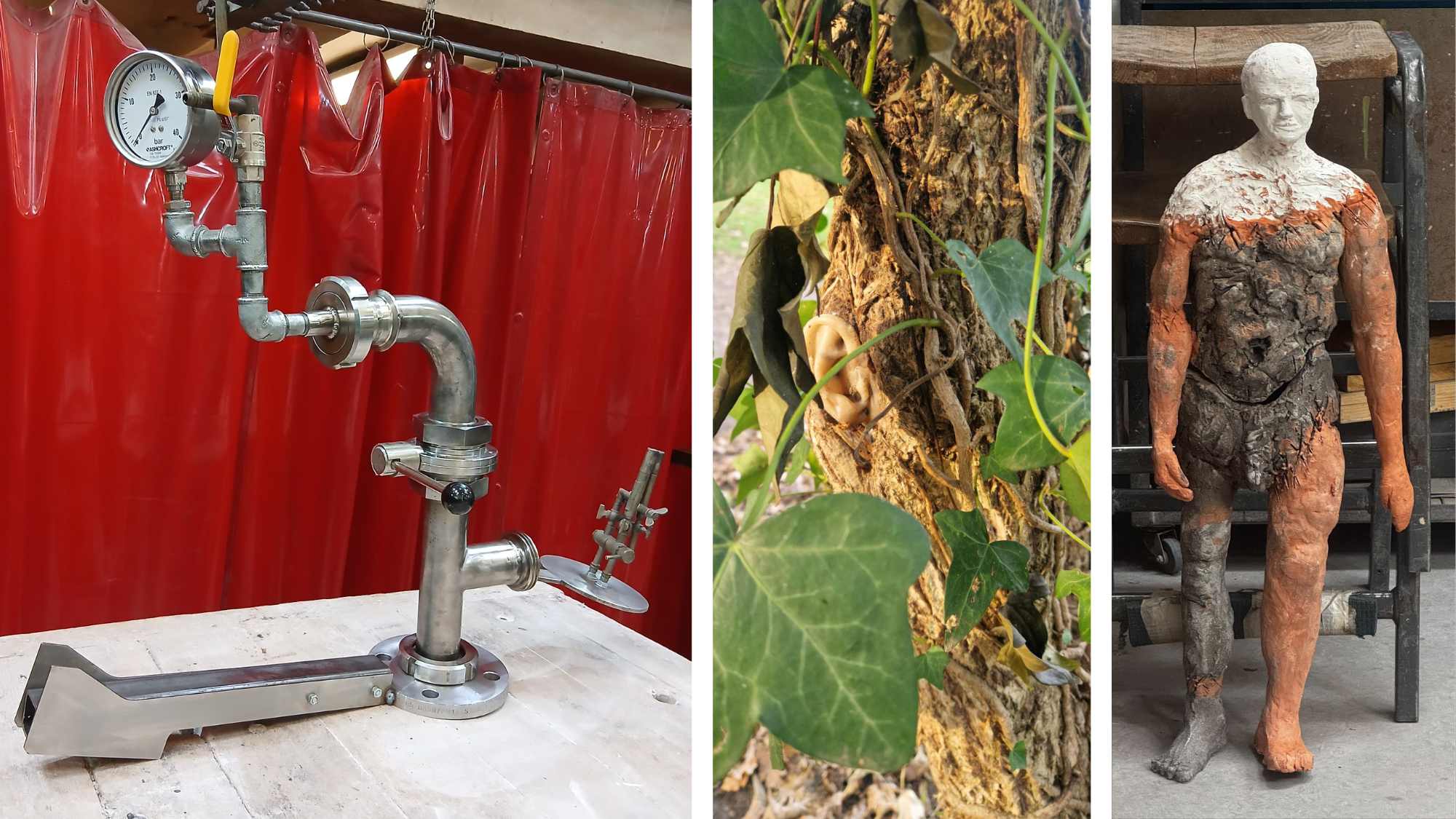
Photographs of works by Rosalind Smith, Michelle Cole and a Group Life Class project work.
Artists’ Statements:
Susan Caffrey
Now I make a leaf of voices celebrates the coming together of people… It is the voices of community -artists and participants, neighbours and passers-by. My piece is a person who wants to speak to anyone who will listen. This person wishes to communicate on terms which will honour the listener and will in turn listen to others, when those others want to speak… If you look at both sides of the artwork, you will see a different self being revealed.
Michelle Cole | @merryshelle @michellecolemoves
I like to work in sculpture, film, collage and drawing. The body and being a body are at the centre of my practice. I’m interested in themes around growth, energy and movement, drawing on ideas and imagery from biology, cellular and embryonic development and explorations of movement through bodywork and practices like Bhutto. I enjoy working in a very exploratory way and am currently working with casting techniques. My submission for Now I make a leaf of voices is about the possibility of learning and sharing through listening to all life, both human and non human. Finding common connections.
Jack Davies | saatchiart.com/en-gb/jackdaviesartist
Wish Box is a place for wishes, prayers and inner voices of the community, to speak of hopes and dreams – artists and participants, neighbours and passers-by; a safe space and sanctuary where we can express our wishes for the future, our thanks for the present and a connection with voices of innovation from the past. At the end of the exhibition Wish Box with be carried to the Thames River and submerged to release the wishes on an outgoing tide. The box is sprayed with a non-toxic paint, kind to fish and marine wildlife.
Brigid Green
The Bee. A bee never speaks alone but is a symbol of the collective voice. Through movement, vibration and chemical signalling, bees create a complex network of communication: a reminder of the fragile interdependence that connects individuals, communities and the natural world. The bee acts as a carrier of these voices, linking all living matter through exchange. Both a singular creature and part of a larger community whose survival depends upon communication, cooperation and shared purpose. In the diversity of living things it creates a shared language of respect for the collective voice, a resonance of countless lives woven together.
JP Guerrier
The purpose of the horn is to both amplify voices, and offer an opportunity for focused, active, and deep listening, capturing sounds that may be easy to miss and voices that might otherwise go unnoticed. These may be the voices of people in and around the churchyard, the voices of nature, or the voices of the city and local community.
Terasa Hedderwick
The representation of universal human experiences, particularly those society finds uncomfortable, is intrinsic to my work. My intentions are to create affective pieces that honour and preserve the experience, exposing the hidden memories and emotions. Repetition is important in my practice, with each repeated piece slightly altered.
Untitled (2026) is about giving ‘voice’ to living with grief; reflecting the piecing together of a changed life, into new ways of being in the world. It resonates with Walt Whitman’s Voices, as without a receptive ear or ‘tympan’, we are unheard and emotions/thoughts are left ‘slumbering’. Grief is difficult to express in a society that doesn’t like acknowledging it, but through the process of making, I find my voice and in a form that our society is more receptive to. The flowing connections of the individual pieces are like words coming together to form an expression that can be heard.
Patsy Hickman
It is exciting to be given an inspirational subject such as Walt Whitman’s poem “Voices”. For me, it opened a door to express what I feel is Everyman’s plea in the year 2026. Three upturned faces call for Peace. To warm their presentation I have added linking doves each holding a traditional twig in their beaks. I have used wire, weighted at the base, yet able to sway at the top with “Peace” written three times in capital letters. We live in a desperate and tragic era. The stark simplicity of this work demands, Who is listening to our plea?
Luke Jones
Head of Adrian – available for sale £975
Susie Lonie | susielonie.com
Two Gargoyles. As a society we are increasingly isolated from nature, the spirit world, and each other. My work seeks to act as a reminder that this solitude is reversible. Inspired by mythological entities and the natural world, my intention is to evoke childhood memories of wonder and limitless potential. Whilst inviting the viewer to imagine, there is also a warning that if we neglect our real or fantasy worlds, we risk losing their richness and diversity.
Kirsten Newbiggen
Walt Whitman’s poem speaks about the power of voices and the spoken word. The poem makes me think about all the people connected to St. John’s Church and how singing together and conversing with each other creates bonds between people. I see the voices, songs and the spoken word as waves of energy surrounding us. My sculpture is an expression of these sound wavelengths connecting in multiple ways and building bonds between people.
Fola Odumosu
Sing to me. To put together this proposal I revisited Walt Whitman’s poem “Voices” and wrote a poem in response, to ask myself – what is voice? Writing the poem made me think about the idea of the voice being our unique imprint and a conduit for reflecting the deepest parts of ourselves. When we sing we are expressing all of these parts and there comes a connection to the ethereal, the earth, the universe. The title of the poem – “As above, so below” makes reference to the paraphrase of text from the Emerald Tablet, which suggests that patterns, laws, and energies repeat across all levels of reality. To me so does the voice and this will be represented in my sculpture.
“As above, so it is below.”
In the sweet quiver of breath and gut and soul.
You are my comingling with cosmos and earth.
For in the deep rumble and moan and whistle and cry,
you are my constellation of all that I have ever heard,
my past lives, my day dreams,
time and now.
You are my affection, my blues, my reaching, my wading, my jubilating and my kin.
So sing to me.
I am your melody, your poetry, your prayer.
Inspiration: My sculpture is inspired by the Tibetan singing bowl, which is an instrument that creates sound that has meditative, relaxing and healing properties when rubbed or hit around its rim by a mallet. For me it captures the power of how music and sound can heal – aligning the physical and emotional body and bring us together in community. “Sing to me” symbolises the power of the voice to connect us to “above” and “below” and invites viewers to find their voice.
The Pelham Clay Slappers
A group project from Tuesday evening’s life and portrait course.
Sabrina Rodrigues
My interpretation of Now I make a leaf of voices focuses on the choir as both a visual and social structure — a space where individual voices come together to form something collective, layered, and resonant. I’m particularly interested in the gathering of people before and after performances, informal exchanges between participants, and the shared experience of occupying space through sound.
In response to the brief, I am exploring the idea of choir block and choir-like arrangements as both compositional and conceptual frameworks. These formations reflect how voices are organised into groups while still allowing for individuality within the whole. I’m drawn to how these arrangements can be translated visually — echoing the structure of a choir through repetition, proximity, rhythm, and collective presence.
Inspired by St John’s Waterloo’s history as a site of music, community gathering, and social renewal, I interpret the brief as a reflection on how collective voices can foster connection, solidarity, and belonging. This work seeks to celebrate both the act of singing itself and the communities that form around these shared vocal experiences — recognising harmony not only as a musical phenomenon, but as a social one.
Rosalind Smith
Under Pressure. The best way to relieve pressure is for like-minded people to gather to exchange ideas and to listen to different views therefore broadening one’s mind.
Thursday’s Children
Rock-a-Bye. This installation is about the unheard voices of the vulnerable, the voices we choose not to hear, those who have no words. One harsh wind, a violent gust and the precarious safety of all our lives can be shattered.
The basket frame is made of recycled steel with an internal wool ‘cat’s cradle’, textile covered handles and a cascade of reused baby clothes with black mourning ribbons. Thursday’s Children is a collaboration of two artists Helen Peacock and Nicola Pirkis.
About Morley College:
Founded in 1889, Morley College London provides lifelong educational opportunities for diverse communities throughout London. With centres in North Kensington, Chelsea and Waterloo, the historic colleges offer a wide range of short courses, adult and higher education qualifications, and qualifications for 16 to 18 year olds. Find out more about Morley College’s history in Waterloo and its offers on www.morleycollege.ac.uk.


About The Waterloo Festival:
The Waterloo Festival is an annual celebration of arts, heritage and community run by St John’s Waterloo with the local community. Read more about this year’s programme: www.stjohnswaterloo.org/wf2026
Getting to St John’s Waterloo: St John’s Waterloo is accessible by bus, tube or train; the nearest station is Waterloo Station. Parking is available in Exton Street on pay bays, Monday to Friday from 8.30am till 6.30pm & Saturday 8.30am till 1.30pm. Payment must be made by phone or app, details can be found on signs along Exton Street. After 6.30pm (1pm on Saturday) parking is free within the bays and on single yellow lines. There are no disabled bays along Exton Street. Parking is also available in car parks in York Road and Cornwall Road, details for both can be found online.